Unfold the Seated Body
Sitting is not neutral; it has a structural cost we must undo
Over the last two centuries, we sit more than humans ever did in the millennia before. We literally evolved for a spatial reality that the modern world has entirely deleted.
The Industrial Revolution gave us doubled life spans, mass literacy, modern medicine, and worlds beyond a 10-mile radius. It also gave us desks, chairs, cars, and couches, and with them a new posture: folded, compressed, and locked.
Mistakenly, we think of sitting as “doing nothing”. You’re just … sitting there.
But this seated body is not neutral and it’s not passive. It is a body being actively shaped by the demands of our commitments, by what everyone else is doing, and by furniture. It is a physical anachronism walking through the modern world. And we suffer for it.
but I’m stuck in this chair
None of this is news to a lot of us.
Even if it’s no mystery where the problem came from, real solutions seem continuously out of reach or opaque. Maybe it’s not actually possible this decade, we might think, like so many other infrastructural life changes that demand both unbuilding and rebuilding.
Throw it in with so many other hashtagged “goals”, like starting your own business, moving abroad, or eating more fiber.
the airplane paradox
In my work, the acute reality of this compression is most obvious in one specific scenario.
Clients will return from active vacations—like exploring Sardinia or Seoul endlessly on foot—yet they walk back into their regular lives feeling misaligned, tight, achy, and run down. There is always pain.
The culprit isn't a lack of exercise.
It is the flight home.
A few hours of enforced, uninterrupted sitting at the speed of 500 mph has more structural impact on the nervous system and tissues than a week of office work. It is sitting without reprieve.
If you’ve been there, then you also know: a 60-minute formal workout block cannot protect or resolve a body’s multiple hours of stagnant compression.
the origami shift
Yet unfolding is possible. Without gyms, and without radical lifestyle changes, we can divert this inherited and self-capitulated experience with deliberate, structural interruptions.
They must be intermittent: open the chest, release the shoulders, move the spine in neglected directions, and remind the hips of their original range, throughout the day.
They also must be as consistent as the sitting they oppose.
To unfold deliberately right in the middle of the day is a rejection of the often-unconscious conception that exercise is something we can either fail or succeed to “fit in” before or after work, and that impactful movement that changes your life belongs only to the gym or the running trail.
freedom = responsibility
Pre-Industrial times were not better (for humans). You had no toilet to flush, owned exactly two outfits, and before you even needed a mammogram, you'd died of smallpox.
Humanity rightly accepts our current sense of life in a human body (varied as it is) as a structural cost in exchange for survival, scale, and a ride to work. Cultivation of the intellect is no longer a privilege of the very few.
Embracing the trade, with a few centuries under our belts to see its costs and benefits, we’re each beholden to "undo" that physical tax every single day. We can transform movement into a constant, non-negotiable structural baseline, bringing both relief and pleasure, rather than an administrative line-item on a calendar or another “should”.
Strength and mobility cannot be luxuries of disposable money or time; they’re everyday acts belonging to a Post-Industrial Revolution.
In a world built on chairs and screens, passive compliance is the default.
A different posture is the disruption that's yours to claim.
in practice
Here are three simple ways to unfold — try one, or weave them together.
Spine and hips are the two places most collapsed by sitting. These movements (two for the spine, one for the hips) individually do more than meets the eye, and together, they hum.
I. Seated Overhead Reach with Side Bend:
Opens the shoulder and waist, relieves stiffness
planes of motion: lateral flexion (frontal plane) & decompression (axial plane)
Scoot your chair back away from your work area so you can hinge forward at the hip. Rest one forearm on the same-side thigh. Feel the spine lengthen.
Reach the opposite arm , elbow straight, creating a long, lateral spinal flexion arc from waist to fingertips. Hold as long as it feels good. Alternate sides.
II. Quadruped Open Book
Mobilizes spine, stretches chest, shoulders, neck, and feet
planes of motion: thoracic & cervical rotation (transverse plane)
Kneel on all fours on a pillow or folded towel (or place hands on the edge of a stable desk, table, or counter assuming a plank position).
Rock the hips gently back toward the heels, toes planted (or anchor the heels on the floor in a calf stretch if standing).
Reach one arm diagonally above and behind your torso, fingers to ceiling, eyes on your hand, opening the chest and twisting the thoracic and cervical spines.
Drive the heel of the supporting hand into the floor or table, to anchor the shoulder blade and leverage a deeper twist. Resist pelvic rotation by gently engaging the lower abdominals. Reverse and alternate, at your pace.
III. The Egyptian Bow
Multi-planar hip extension and safe thoracic extension against a fixed anchor
planes of motion: sagittal extension (hip/thoracic) & asymmetric diagonal loading
Stand sideways next to a wall in a staggered, hieroglyph-style walking stance, with your wall-adjacent foot stepped forward.
Rotate the chest toward the wall while keeping your pelvis facing straight ahead, and place both palms flat at shoulder height.
Reach the arm closest to the wall long overhead, pressing your palm into the surface for stability.
From this position, gently lean your hips away from the wall to create a long, continuous arc from the back foot to your top hand.
To deepen the extension safely, lift the breastbone slightly to open your clavicles and extend the upper thoracic spine without pinching your lower back. Hold as you breathe deeply, visualizing the bow. Switch sides.
IV. Frog Squat Stretch
Releases hips and low back, stretches calves and ankles
planes of motion: deep bilateral hip/knee/ankle flexion (sagittal plane) & posterior fascial release
Stand with feet slightly wider than hips, toes turned out.
Lower the pelvis into a deep squat, hands on a chair or stool for balance and/or sitting on a step or low stool if needed. Drop as low as comfortable, aiming to “sit on a toadstool,” knees pointing toward toes.
Let the head hang heavy, chin to chest, pulling apart the shoulder blades, to uncoil the deep tissue of the back line and add a neck/upper back release.
Breathe deeply in through the nose, out through the mouth, letting the belly release and contract. Hold up to 1–2 minutes.
structural autonomy is structural integrity
Repeat these as a strategic disruption to your environment, scheduled or unscheduled.
Unfolding the seated body has three distinct thresholds:
The acute awareness of exactly when extended stillness is impacting your system.
The willingness to experiment with moving at times and places where stillness is culturally expected.
The absolute openness to prioritize self-preservation over performance.
Barroco Press Catalog:
Rest Architect Field Guide: Timed Recovery in Strength Training (Strength Training Field Guides, Vol. 1)— PDF volume with its companion, Rest Architect Pocket Guide [$12].
Training Strategy Review— Bespoke training audit and structured strategy blueprint. Delivered asynchronously as a comprehensive PDF [$325].
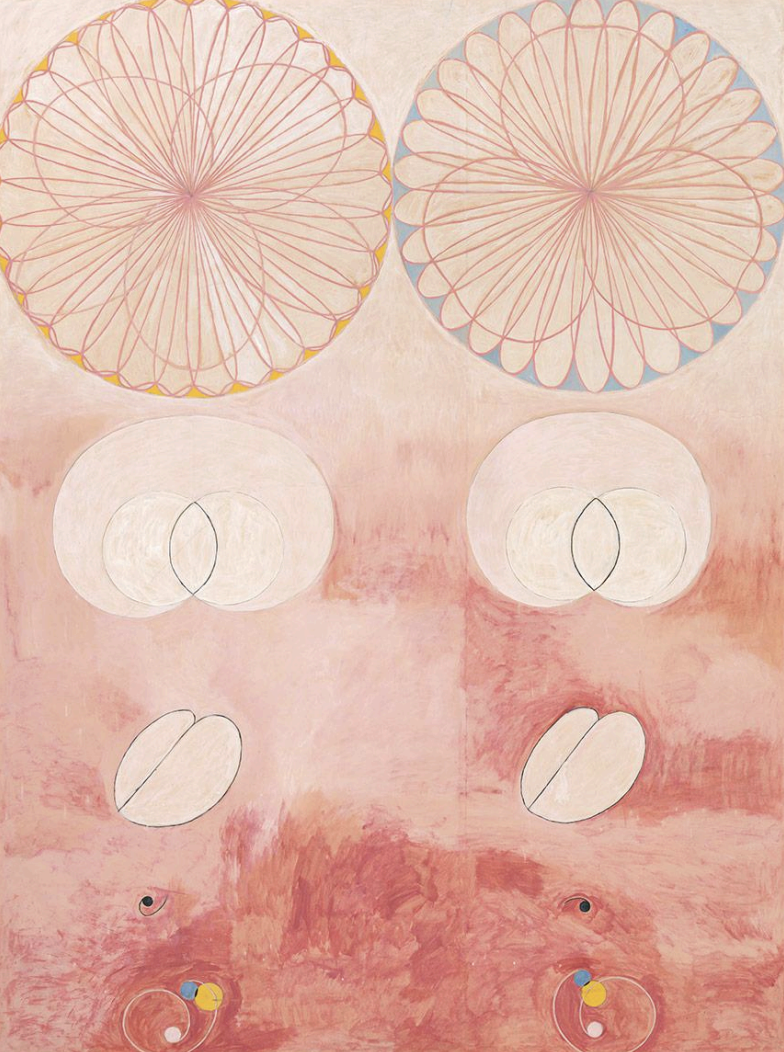
Image: Hilma af Klint, Group IV, The Ten Largest, No. 9, Old Age, 1907 (Public Domain).